
Replace a chimney cap when it is rusted through, bent, loose or missing, or when its mesh is torn or clogged with soot. A cap in good shape keeps rain, birds, animals and debris out of the flue and still lets smoke and exhaust leave the chimney.
What a chimney cap does
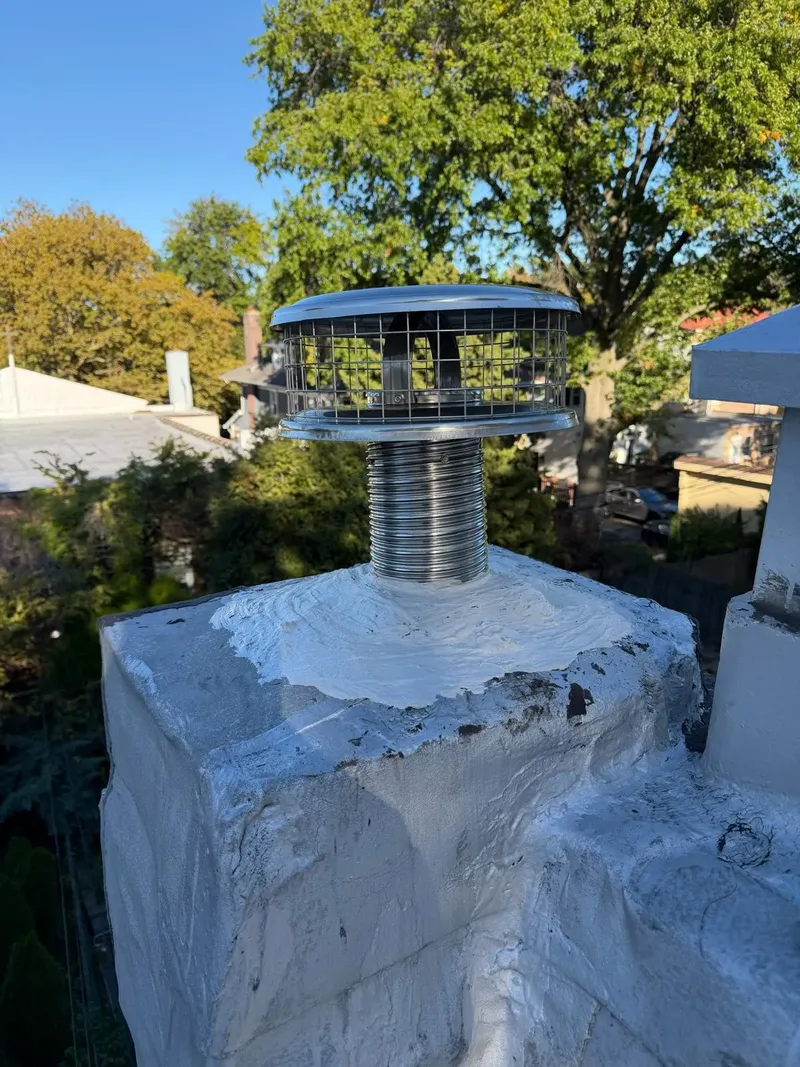
A cap is a metal lid on legs with mesh sides, fixed to the top of the chimney. The lid sheds rain and snow. The mesh keeps birds and squirrels from nesting in the flue and stops leaves and roof debris from falling in. Between the lid and the top of the flue, the open sides let smoke and gases out.
Without a cap, rain falls straight down the flue. Over time it wears out the mortar and the liner, rusts the damper and leaves water in the firebox. An open flue is also an easy place for a bird to build a nest, and a nest can block the flue completely.
Signs your cap needs replacing
- Rust holes in the lid or the mesh, or rust streaks running down the chimney
- A cap that is loose, tilted or bent, often after a storm
- No cap at all, or a cap that covers only one of several flues
- Mesh that is torn, so birds or animals can get in
- Mesh that is clogged with soot or creosote, which can slow the draft and push smoke back into the room
- Water in the firebox, or animal sounds in the chimney
You can often see the cap from the street or the roof. If you are not sure, a chimney inspection includes the top of the chimney, and we tell you whether the cap is doing its job.
Single-flue and multi-flue caps
Many Brooklyn chimneys carry several flues side by side, one for each fireplace and another for the boiler or water heater. You can cap each flue on its own, or cover all of them with one multi-flue cap that sits on the chimney crown. A multi-flue cap covers every flue at once and gives the top of the chimney one roof against the rain. You can see both kinds in our photos of chimney caps.
A stainless steel liner that runs to the top of the chimney gets its own round cap on top of the liner. When we install a new liner, the cap is part of the job.
Stainless steel caps
We install stainless steel caps, sized to the chimney and fixed to it, so the wind does not lift them. Caps made of galvanized steel rust sooner, and once the lid or the mesh rusts through, the cap stops keeping rain and animals out.
Some chimneys use a turbine cap, a vent that spins in the wind. We install and replace those too, when the chimney or vent calls for one.
How we replace a chimney cap
- We look at the top of the chimney and measure the flues and the crown.
- You get a flat-rate quote for the job before any work starts.
- We remove the old cap and fix the new stainless steel cap to the chimney.
- We check the top of the flue while we are up there and tell you what we see.
The quote depends on the size of the cap, the number of flues, the access to the roof and the materials. If you also want the flue swept or inspected, we can do it in the same visit. See chimney sweep and cleaning.
When to replace it
Any time the cap is damaged or missing, and before the heating season if you can. A cap keeps water out all year, but fall is when most people check their chimney, and the inspection that comes with a sweep is a good time to look at the cap as well. More in how often to clean and inspect a chimney.
How to start
Use the quote form, or call or text (646) 290-6327. Tell us how many flues the chimney has, if you know, and the type of building. More about our chimney cap work.